
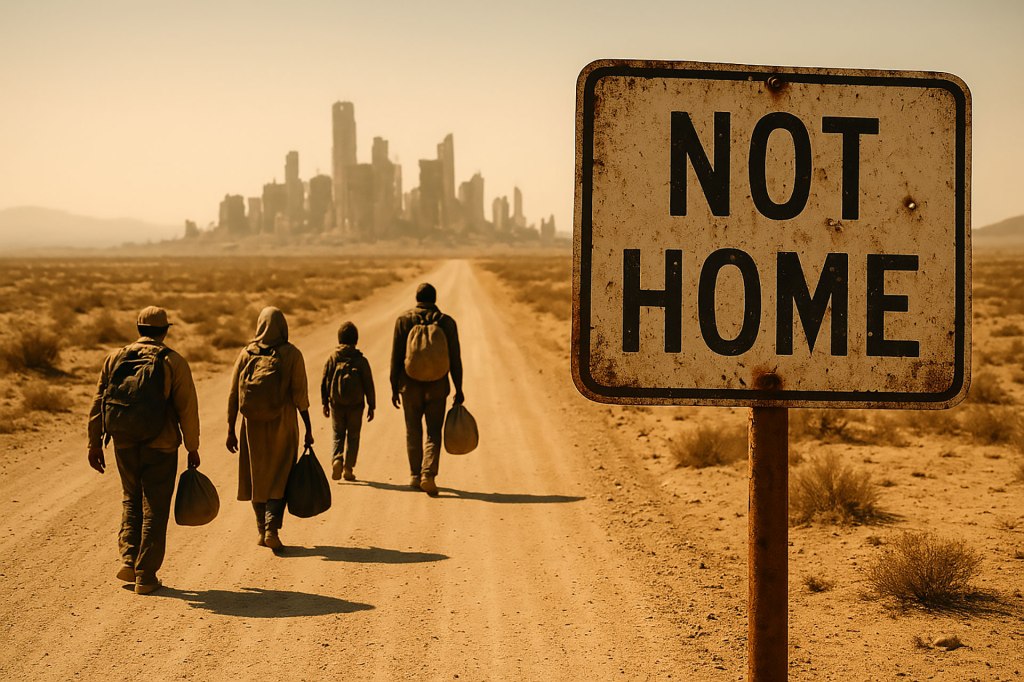
What Refugee Outcomes Reveal About Our Assumptions and Ourselves
One observer’s uncomfortable question about refugee integration, and what happens when data doesn’t align with popular narratives.
The Uneasy Feeling We’re Told to Ignore
Some conversations are hard to have, not because the facts are unclear, but because the emotional cost of expressing them is too high.
When someone notices a troubling pattern in their city, one that touches race, culture, and integration, they often stay silent. Not out of apathy, but fear. Fear of being labeled. Fear of being misunderstood.
This article comes from that place. A place of curiosity, discomfort, and honesty. It’s about what happened when one person saw two groups of refugees arrive in a North African city, both displaced, both vulnerable, but only one group seemed to progress.
What does that mean? And why does it feel dangerous to ask?
The Observation: Two Groups, Two Trajectories
A few years ago, two large waves of refugees arrived in a North African city.
The first wave came from Syria, people fleeing war, persecution, and devastation.
The second wave came from West African countries such as Mali and Niger, where civil conflict, chronic poverty, and political instability forced people to leave their homes in search of safety and opportunity.
At first, both groups shared a similar reality: unfamiliar streets, aid dependency, manual labor, and uncertainty. Some turned to begging. Others tried to survive day by day.
But over time, something began to shift.
Syrian refugees, slowly but steadily, started opening businesses. Small convenience stores. Food stands. Phone repair shops. Some joined local trades or began hiring other Syrians.
Meanwhile, the West African refugees seemed stuck in the same place. No visible signs of economic mobility. No clear path forward.
It was a contrast that anyone paying attention could see. And yet, few dared speak it aloud.
The Dangerous Question: Is it Racist to Ask Why One Group Progresses and Another Doesn’t?
In today’s climate, noticing differences, especially when those differences involve race or region, can feel like stepping on a landmine.
Many fear that even asking “why” will bring accusations: of racism, of stereotyping, of lacking empathy.
But silence doesn’t help. And pretending the disparity doesn’t exist helps even less.
So we ask the question, not to judge, but to understand:
Why did two similarly displaced groups, starting from similar conditions, end up on such different paths?
The Cost of Stagnation: When Refugees Get Trapped in the Margins
Refugee stagnation is not just a sad story. It’s a social tragedy with real consequences.
When people arrive in a new country and are offered no path forward, no jobs, no training, no community, they don’t simply remain invisible. They fall through the cracks. And what’s waiting at the bottom isn’t pretty.
Crime and Survival Economies
With no income and no legal work opportunities, some turn to theft, fraud, or underground markets. Not out of malice, but out of desperation.
Petty crime becomes survival. Gangs offer identity. Drug routes offer money. This isn’t the norm, but it becomes common enough to reinforce stereotypes.
Social Collapse
With no sense of progress, hope erodes. Families break. Mental health declines. Some disappear into addiction. Others lose the will to try. Children grow up on the fringes, absorbing bitterness, surrounded by failure. This stagnation becomes generational.
Rising Racism
As crime and poverty become associated, however unfairly, with a particular group, resentment festers. The local population sees a group stuck in place and assumes laziness or criminality.
Racism doesn’t always begin with hate. Sometimes it begins with confusion, then frustration, then fear.
And when people are afraid, they look for someone to blame. The refugee becomes the scapegoat. And the cycle continues.
When the Easy Way Becomes the Only Way
There comes a moment, often quietly, when survival shifts from urgent struggle to learned strategy.
Among some groups of West African refugees in North Africa, that shift took shape in the form of informal street economies, organised begging, parking scams, petty hustling. On the surface, it looked benign. No violence. No theft. Just people finding a way.
But something else was happening beneath.
When enough people start relying on those informal systems, they become self-reinforcing. Young newcomers quickly see where the money flows. Honest work, if it exists at all, is grueling, underpaid, and often humiliating. Meanwhile, sitting outside a café all day asking for coins? That pays. Especially if it’s coordinated. Especially if it’s ritualized.
And so a quiet logic sets in:
“Why chase jobs that don’t want me, when the streets at least offer something?”
The danger is not just in the activity, but in the normalization of it. A culture of resignation begins to grow. And with it, the stereotypes.
Locals begin to see the same faces in the same places, day after day. They stop seeing struggle and start seeing choice. That choice, real or perceived, becomes the foundation of blame.
And then the cycle deepens. The group that’s already marginalized becomes more visibly “other.” The walls around them get higher. Opportunities shrink further. And honest work, already scarce, starts to feel not just out of reach, but irrelevant.
What the Data Suggests: This Isn’t About Race, It’s About Context
The divergence isn’t rooted in biology or cultural superiority. It’s rooted in systems. Histories. Structures that quietly shape outcomes.
Let’s look at some of the likely forces at play:
1. Educational Background
Before the war, Syria had one of the highest literacy rates in the region. Many refugees arrived with training in mechanics, tailoring, electronics, and small business.
By contrast, many West African migrants came from rural or nomadic communities where access to formal education is low, and vocational training almost nonexistent.
2. Language Barriers
Syrians often speak Arabic, an immediate linguistic advantage in most of North Africa. West African migrants speak a variety of languages, often tribal or regional, which makes integration harder and communication difficult in the job market.
3. Diaspora Networks
Syrian communities had a pre-existing presence in many countries. Diaspora networks can offer loans, housing, employment, and a social safety net.
West African migrants, especially from more isolated rural areas, often arrive without any such connections.
4. Economic Transferability
A Syrian baker or plumber can find work, or start over with modest capital. But a Malian herder or subsistence farmer faces an urban environment where none of their life skills are useful.
5. Perception and Bias
Syrians are often seen as victims of a defined war. West Africans, however, are frequently subjected to generalized assumptions, of criminality, of economic migration, or of being “out of place.” These perceptions affect how society, employers, and law enforcement treat them.
When Integration Is Not on the Menu
If you ask the average host nation official, they’ll say the right things: We support refugees. We respect human rights. We’re doing our part.
But look closer.
What you’ll find, more often than not, is not outright rejection, but systematic misery by design.
No clear path to citizenship. No work permits. No training programs. No long-term housing. No education for children. And worst of all, no plan. Just endless paperwork, limbo, and polite deferrals.
The reasoning isn’t always rooted in cruelty. Sometimes, it’s fear.
Governments worry about the economic burden of integrating thousands, if not millions, into fragile job markets. They fear cultural clashes, demographic shifts, long-term political instability. So instead of facing those fears with policy, they hide behind inertia.
The message isn’t shouted, but it’s unmistakably clear:
“You are not welcome to stay. And we will make life just uncomfortable enough for you to leave on your own.”
This passive cruelty avoids headlines, but it wrecks lives.
People can survive hardship, but not ambiguity. When refugees don’t know what tomorrow holds, when they can’t build, invest, or plan a future, they lose the will to participate in society at all. They’re not just poor, they’re invisible.
Worse, this ambiguity is often framed as generosity:
“We haven’t deported them. We allow them to be here.”
As if mere presence is kindness. As if existence, without dignity, is a favor.
But integration doesn’t happen by accident. It requires intention. Structure. Support.
When a host nation fails to provide those, and still pretends to stand on moral high ground, it creates a quiet hypocrisy that everyone sees but no one names.
The result? Refugees remain outsiders forever. Society loses their potential. And resentment brews on all sides.
If We Don’t Ask Why, We Miss the Real Solutions
Refusing to talk about disparity makes it impossible to fix it.
Instead of dismissing people who notice these patterns, we should reward them for their honesty, and take the opportunity to ask better questions:
- Are our integration programs -if they exist- tailored to people’s backgrounds?
- Are we offering training and education that reflects reality, not assumption?
- Are our institutions free of implicit bias?
- Are we confusing equality of treatment with equality of opportunity?
If we truly want to help refugees thrive, we need to stop talking about them like one undifferentiated group. Context matters. History matters. And honest reflection matters most of all.
Conclusion: Honest Observation Is Not Hate, It’s the Beginning of Change
The person who noticed this pattern wasn’t hateful. They were paying attention. They saw something others ignored and had the courage to ask:
“Why is this happening?”
They didn’t offer easy answers. They didn’t assign blame. They just wanted to understand.
And understanding is where real change begins.
Because if we can’t talk about what’s not working, we’ll never build what could.
Final Note:
Let’s make room for the hard conversations, the ones that start with discomfort but end in deeper truth. Let’s reject silence. And instead, choose the path of curiosity, empathy, and structural honesty.
 Slimane Kemiha - Blog
Leave a comment